Counted Out: The Willful Ignorance of Excluding LGBT Americans from the US Census

Originally published to Chosen Magazine on April 19, 2018.

By Evan Brechtel

The adage is trite, but there really is strength in numbers. Supervisor Harvey Milk, the first openly gay official elected to public office, knew this in 1978 when he implored queer people of the nation to come out and, in turn, “break down the myths, destroy the lies and distortions. For your sake. For their sake.” Milk knew that once the straight majority saw LGBT people as their siblings and their friends and their co-workers and others, the “sin” of queerness would no longer be a shrouded, insidious menace, but a quality shared by scores of admirable people.

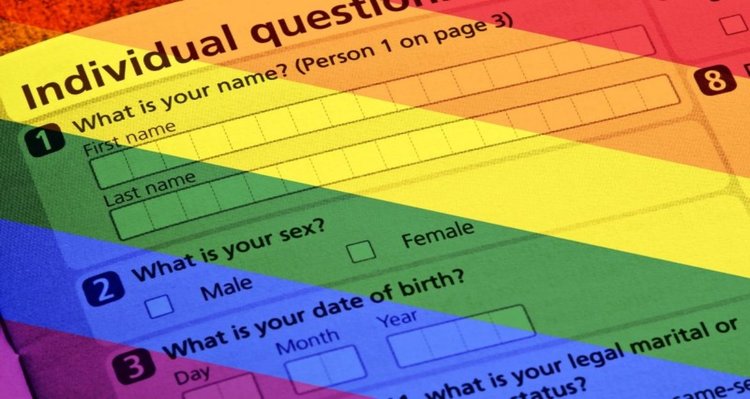
While LGBTQ people have, to varying degrees, achieved increased visibility and more readily available information in the first two decades of the twenty-first century, the decennial census will continue to fail us. While the census has included an “unmarried partner” option for couples regardless of gender since 1990, and will include “unmarried same-sex partner” and “married same-sex partner” options beginning in 2020, this is not so much progress in itself as it is a result of same-sex unions now being federally recognized. Despite requests from the Obama-era Justice Department, the Department of Housing and Urban Development, the Environmental Protection Agency, and the Centers for Medicare and Medicaid Services pleading for census questions covering sexuality and gender in order to better do their jobs, the current administration has deemed that no more information is needed. The 2020 census will not count single lesbians, gays, or bisexuals, nor will it begin to account for trans and gender nonconforming Americans of any relationship status. The United States government is keeping us in the closet by maintaining ignorance to better shirk the responsibility of creating a safer America for its queer inhabitants.

Other than the misallocation of funds and resources that this continued exclusion allows, it severely hinders our influence in a legislative arena. Historically, mapping our numbers and collecting data has led to increased mobilization and greater hope for a future over the rainbow, however these studies have nearly all operated under limited resources and less-than-ideal sample sizes. The most famous of these was undoubtedly the Kinsey study.

Primarily a zoologist, Alfred Kinsey noticed that the moral vigilance of post-WWII America had delayed the advancement of reproductive research and denied many Americans knowledge of their own sexuality. Through thousands of anonymous interviews with people of all ages, Kinsey charted American sexuality with a frankness and scientific sterility that would eventually legitimize sexology as a study. When the first volume of findings, Sexual Behavior in the Human Male, was released, Americans began to realize that their darkest desires and basest fetishes were actually not so out of the ordinary. This was especially true for gay people. Among Kinsey’s most incendiary findings was the report that thirty-seven percent of American males had had at least one homosexual experience leading to orgasm. For twenty-five percent of those men, the experiences were “more than incidental” over a period of three years. The common (and debatable) figure of “around ten percent” of Americans having same-sex attractions comes from averaging the seven percent of women and thirteen percent of men who were found by Kinsey to be “predominantly homosexual.”

While in-depth research is more accessible to scientists and scholars today, the Kinsey reports told gays and lesbians that there were swathes of others like them. For the first time in centuries, society began to question if same-sex attraction was indeed as abnormal as they’d been taught. Kinsey’s studies were the early rumblings of what would form the sexual revolution and the Gay Liberation Front of the 1960’s nearly a decade later. “Homosexuality was thought to be a very rare phenomenon. There was nothing in the literature that concerned well-functioning gay males,” said Dr. Evelyn Hooker. “Kinsey gave great hope. They were not a tiny minority but actually a very sizable proportion of the population.”

Hooker would go on to do groundbreaking research of her own. The psychologist began attending meetings of early gay rights organization The Mattachine Society at the urging of her friends who were members. Because the society was constantly under scrutiny by the House Un-American Activities Committee (with undercover FBI agents infiltrating several Mattachine chapters), members were highly selective with their trust. Yet at members’ invitations, Dr. Hooker began attending more meetings and collecting data from her friends in Mattachine. In an effort to advance her studies, she applied for a grant with the National Institute of Mental Health to study the mental states of gay men. With McCarthyism in full swing and thousands of outed gay and lesbian federal employees losing their jobs, Hooker was amazed to find that the Institute accepted her grant.

What resulted was a revelatory study of the psyches of gay men. Using thirty self-identified homosexuals and thirty heterosexual men, Dr. Hooker and her team performed psychological tests and presented them to other psychologists to see if they could discern from the tests alone who was gay and who was straight. They couldn’t. Though the men in her field leapt to discredit her when the findings were published, Hooker paved the way in proving that homosexuality is not a mental disorder. The United States government was actively contributing to the persecution of queer people, but the Institute of Health’s grant nonetheless endowed the study with greater credibility and more expansive resources.

This is why the government counting us is an imperative step in the forming of comprehensive policies and safer conditions for queer Americans. By failing to account for the vast majority of LGBTQ people, the ruling body maintains a level of plausible deniability, allowing lawmakers to dismiss identities like nonbinary genders as absurd—sentiments their constituents often parrot. In the case of the Kinsey Report, gay men and lesbians could begin visualizing just how vast the homosexual population in America was. A census that is comprehensive in regards to gender could, like Kinsey’s findings, reveal a greater ubiquity of identities that don’t subscribe to binary or anatomical constraints, potentially creating a situation in which the current administration would have to contradict its own data in order to “reasonably” maintain this ongoing subjugation.

Queer people are constantly made to defend the validity of our own existences, and we’re damn good at it. Since the 2010 census alone, we’ve seen the repeal of Don’t Ask Don’t Tell, we’ve seen the first openly transgender woman (Amanda Simpson) appointed to a government post by a U.S. president, the first national monument dedicated to LGBTQ people (Stonewall), a transgender woman (Laverne Cox) on the cover of Time magazine, and, of course, nationwide marriage equality. The advancements forged by LGBTQ people in the last decade have completely transformed the political and societal approach to sexuality and gender. An administration that refuses to recalibrate to these developments with such fundamental means as the self-identification of its own citizens is choosing the comfort of ineptitude over the health and safety of its people. That is an abomination.
Peace of History


The cold wind gnawing at our contorted faces finally relents. Our cheeks relax and the door to his fortress slams behind us. My eyes adjust to the lush red terrain of the lobby’s floral carpet while gold light thaws all traces of the indigo West Village sky.

All these years in the city and I can’t remember seeing a carpeted lobby that wasn’t in a theatre I paid to go to or a hotel guys paid me to show up at. We follow the flat red garden up the stairs. He’s leading with my hand clasped in his and I can’t help but watch his body shake under the black slacks. I’m used to guys in suits, but I see myself having fun with this one for a change. He’s younger than my other clients. Maybe even younger than me.

He effortlessly brings his long brass key through the slot of the mahogany door. After the fancy lobby, I’d expected a penthouse or something. Even though it’s only one room, the grandeur makes it intimidating. It seems to tower over us. And yet he’s almost apologetic as he turns turns to face me.

“It’s smaller than I’d like, but I’ve tried to make it home.”

“No, It’s…” I lose my words and look around. The room is a relic. I jump as the ancient, lacquered wood of the floor creaks in protest against my steps. Still, I go further into his lair, hiding my glances over the knicknacks and ephemera strewn across the space, but curiosity prevails as usual. Old movie posters—”Of Human Bondage,” “Salome,” “Morocco,” “His Girl Friday.” One hangs proudly above a dresser with silver octopus bookends, tentacles outstretched, flanking tattered texts: Maurice. The Well of Loneliness. Other Voices, Other Rooms. The City and The Pillar. Giovanni’s Room. My eyes are on a marble bust when he catches me staring at it.

“It’s Alexander the Great, He was gay too, y’know. Well. Bisexual.”

“You’ve got quite a…collection.” Normally, this is when the guy starts unzipping his fly or cupping my junk, but instead he reaches for his nightstand. Somehow, I only just notice the majestic gramophone resting on top, horn blossoming beside the bed as though you could water it—metallic but fertile, even golder under golden light. He assigns a record and expertly places the needle. The LP whirrs and a man’s voice starts to croon.

He’s my guy,

I don’t care what he does,

Cause he’s my guy.

I guess he always was.

He’s careless

About me.

I don’t think he tries.

I’m confused. The record, the song, the singer are all from fifty years ago at least. “Men could sing about men like this on record?” He doesn’t laugh at my pun.

“This one’s special. Mail order only. From the gay rags.” He sheds his tweed blazer and unlatches his suspenders. At least he’s not wearing a fucking fedora.

“Who’s the singer?”

“I don’t know.”

“But you played it,” I insist with as much playfulness as i can muster to mask my genuine curiosity.

“Nobody does. He had to do it anonymously.”

I can’t tell yet whether this dude is Oscar Wilde or Jeffrey Dahmer and I hate that that turns me on.

But once in a while,

He’ll kiss me and smile

And I can see me in his eyes.

Oh, he’s my guy.

I know he’ll always be.


I take refuge in the smiling and nodding I’ve gotten so used to in this line of work, putting my hands firmly on his broad shoulders before cascading them down to the small of his back. “So…wanna get started, stud?”

He glances downward then pipes up timidly: “I’d sort of hoped we’d just talk. Or at least talk before we…”

Oh god, he’s one of those, I think through a smile, despite feeling my eyes deaden. Johns always try to do this. They try to be the savior to the hustler. I’ve gotten so good at spotting fake altruism. They don’t do it out of genuine concern cause, deep down, they know I’ve got my shit together. No. They try to save me ‘cause they want to be special to me. To be special at all. That’s one satisfaction I can’t give them. Not for all the money in the world.

He reaches for a decanter half full of amber liquor. The starbursts etched into the glass bottle seem to reach for him too.

“Would you care for some bourbon?”

The booze presumptiously sloshing into the crystal tumbler tips the scales in his favor. “Sure.”

And I will try

To keep him lovin’ me

However he wants me,

I’m his until I die,

For nobody knows better than I

That he’s my guy.


I take a cautious sip and ask the most unoriginal New York question I can muster. “So…What do you do?”

“I’m a secretary.”

I try my damndest to stifle a derisive snicker. “You don’t look like a secretary.”

“I’m skilled at pretense, I guess. Are you trying—are you an actor?” His eyes are melancholy.

I’m sure as hell acting unaffected. “It’s what I’m studying at the moment.”

“Study it closely.”

I detest unsolicited advice. “Thanks.” I take a bolder swig of bourbon. “You seem too young to be like…this.”

“Like what?”

“Well…to be honest…it’s kind of like watching a puppy in a top hat and a monocle,” I confess with the assurance of his money safely in the pocket of my jeans.

“I feel good here.” He doesn’t sound triumphant. The gramophone wails and I think he fights the urge to do the same when he collapses onto the bed. I’m sitting at his desk amidst a sea of papers. He isn’t inviting me. He doesn’t know what to say. He only laughs in protest against an impenetrable pain I know he’ll never let me see. Not for any comfort of the present. Not for all the money in the world.


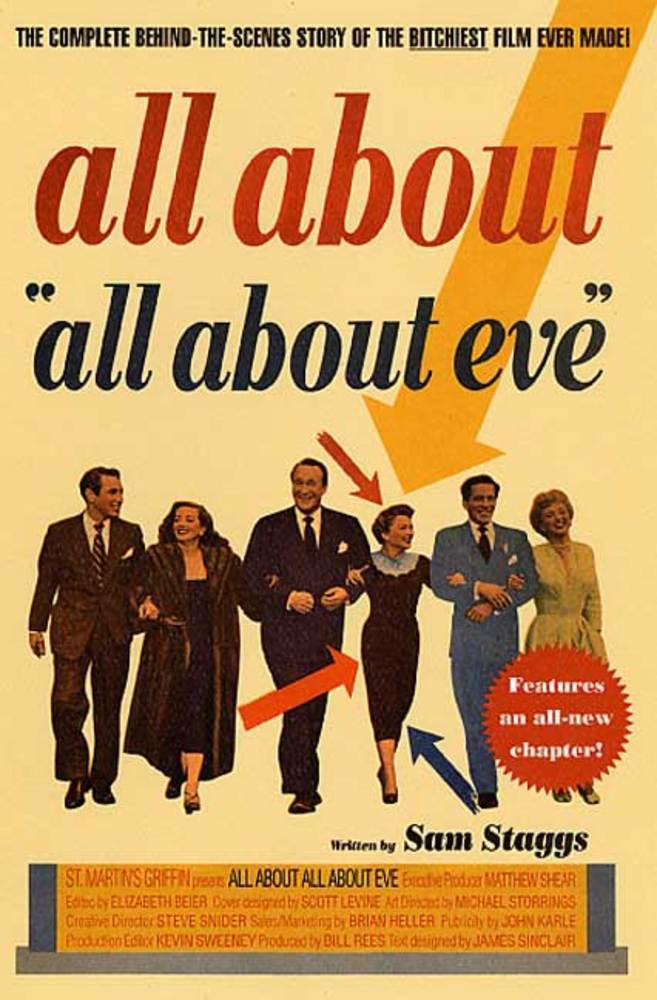
“All About ‘All About Eve'” by Sam Staggs

This is a rigorous look into the origins, development, and subsequent influence of one of my favorite movies ever. Though it feels somewhat like a tabloid at moments and Staggs occasionally grasps at straws to make connections that aren’t there, it’s exhaustively researched and I’ve never watched “All About Eve” the same since.

“But I’m A Queer Leader!”: Racism And Our Dismissal Of It In The Community

Originally published to Chosen Magazine on February 11, 2018

By Evan Brechtel

It’s about three Fridays ago. I’m at Rise in Hell’s Kitchen, somewhere on my second whiskey, which is always when I begin making friends. Three of us–still somewhat strangers–are outside smoking.

“So you guys live in Manhattan?” he asks.

“Yeah, in Harlem,” the two of us reply.

He whips his head back, the breath expelled by his wheezy laugh visible in puffs across cold night air. “Harlem isn’t the city.”

“Sorry?”

“Manhattan ends at 96th Street.” He thinks he’s being informative. “Harlem isn’t the real city.”

We begin pressing him as to why he believes this with such unrelenting conviction. What was different enough about Harlem to exclude it from Manhattan? Its physical structures–its brownstones, its gridded streets and avenues–are practically indiscernible from the rest of Manhattan’s physical makeup. Its history is some of the most illustrious of any Manhattan neighborhood.

“It’s just, y’know…different. It’s just not Manhattan.”

If Harlem’s difference as a neighborhood discounts it from the city, then what–to this man outside the bar–is Manhattan, is New York, if not a collective of varied inhabitants and complex histories? Harlem is not Hell’s Kitchen as Hell’s Kitchen is not the Village as the Village is not the Bowery and so on. None of these neighborhoods are alike and all of them bond to form Manhattan.

He refuses to concede that his statement is factually, geographically, catastrophically wrong, nor will he admit that he’s deemed Harlem irrelevant because of its blackness. This mindset among white gays is rampant. Whether it’s a new Beyonce single or a reaction gif or AAVE, we eagerly consume black artistry, terms, and identities; yet when it comes to addressing our unconscious racism or fighting white supremacy in our own spaces and calling out those in our own communities, we’re deafeningly silent.

Unsurprisingly, this is by no means a new phenomenon. At the height of the Harlem Renaissance, white gays used to flock uptown to evade the Vice Squads, who predominantly concerned themselves with white neighborhoods downtown. White queer people not only went to Harlem to feel safe, but as a form of speculation, as though Harlem were a zoo. Queer historian Lillian Faderman elaborated on this: “Made braver by bootlegged liquor, jazz, and what they saw as the ‘primitive’ excitement of Africa, they acted out their enchantment with the primal and erotic. They believed that Harlem gave them permission, or they simply took permission there, to explore what was forbidden in the white world.” The idea that Harlem is some sort of wasteland until white people find it useful continues to echo today as gentrification forces generations of Harlemites from their homes.

While Cosmopolitan referred to Harlem as “synonymous with naughtiness” during the Renaissance, many of these so-called naughty enclaves simultaneously served as bastions of black success and economic self-reliance in the face of ceaseless subjugation. Buffet flats—after-hours, unlicensed nightclubs—were known to white tourists for sex shows and other acts seen as sinful and salacious. But the buffet flats were far more than scandalous clubs. Not only did they act as hotels for those whom segregation left without a room, but they also functioned as banks for Pullman Porters—exclusively black train porters who founded the first black workers’ union around the same time. The porters’ jobs demanded extensive train travel, and they relied widely on buffet flats to store their earnings and valuables. The partnership between Pullman Porters and the buffet flats wasn’t only mutually beneficial—it was beneficial to all of black America. The flats would store black-owned newspapers such as The New York Age and New York Amsterdam News for the Pullman Porters to pick up before smuggling them through segregated trains and disseminating them across the Jim Crow South, where black-owned newspapers were seen as a threat to white control. Under the noses of the outsiders who’d fetishized Harlem, its most infamous corners were continuing a revolution that is yet to be complete.

The sentiments of the man outside of Rise are reflective of an infinitely greater problem. Despite over a decade of white queer New Yorkers relying on Harlem for the freedom to revel without fear, we didn’t reciprocate that inclusion in the decades after, especially as queer bars became more profitable. A number of these bars continue to fail at creating spaces for marginalized people to safely celebrate. Discriminatory practices such as targeted dress code requirements, exorbitant cover charges, selective ID policies, and more have pervaded since at least the sixties. And it hasn’t been regressing.

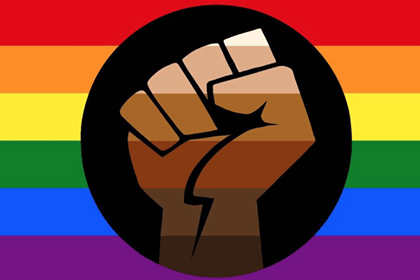
Last year at iCandy, a Philadelphia queer bar, the owner was caught on tape repeatedly assaulting black patrons with hate speech and racial slurs. In response, Philadelphia’s Pride Committee added a black stripe and a brown stripe to symbolize the disproportionate challenges faced by queer people of color. Tellingly, this addition was met with more backlash by the LGBTQ community than the racist actions that necessitated it. As recently as last month in New York, a notable queer bar owner was accused of discrimination, resulting in ceaseless attempts to discredit the accuser, despite two years’ worth of similar accusations against the owner readily available on the bar’s Facebook page.

So often, silence looks like solace from the threat of discomfort, but the evil—the systemic degradation of the soul—that white supremacy upholds is far more harmful than any unwieldy discussion or narrow path to progress. The white people of our community owe it to the humanity of people of color to ensure that queer spaces of revelry are safe for all, and we owe it to them to provide a platform for voices that routinely go unheard. This routine exclusion is not only directly dehumanizing to people of color, but the absence of their voices and ideas is a hindrance to the progress of the entire community. White queers must use our platforms to elevate today’s Bayards and Bessies and Baldwins and Basquiats. We must challenge our own discomfort to better fight these systems with our words and our bodies. The very term “queer” developed from finally questioning and rallying against regressive social norms. There are those who will dismiss these sentiments as another instance of excessive conformity to treating people with respect, but I’m here to assure you that few actions could be more rebellious—more queer—than actively fighting insidious structures and addressing evil as evil.

The New Icons

Originally published to Chosen Magazine on January 9, 2018

By Evan Brechtel

There’s a thrilling moment in the 1930 film Morocco. Marlene Dietrich—famously clad in top hat and tuxedo—entertains a crowded bar before singling out one woman, pulling a flower from her hair and cradling it between her fingers. “May I have this?” she asks the captivated woman.

“Of course,” she replies. Dietrich briefly caresses the woman’s chin, then—in a 1930 film—she kisses the woman on the mouth. The woman hides her blushing face behind a fan and the patrons of the bar erupt in laughter. It’s only a flicker of affection intending to parody the entitlement of men to women’s bodies, yet I often get chills watching this moment, wondering what queer eyes must have thought upon first seeing it.

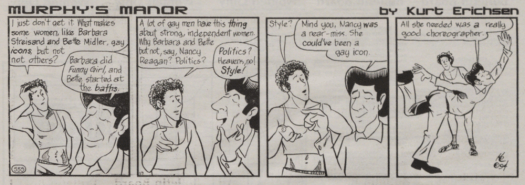
Sixty-two years later, while writing her obituary in Gay and Lesbian Humanist, Terry Sanderson would describe Dietrich as “the last of the great gay icons.” He would go on to say, “There was always a huge gay contingent, worshipping at the shrine of a creature that was only half human—the other half was pure myth.” Sanderson’s reverence for Dietrich is one of countless incidents of historical adoration between queer people (most famously, gay men) and our icons.

While this reverence may seem hokey today, in the early twentieth century, these icons were not merely entertainers. They were essential to our community (many of them, Dietrich included, a part of it themselves) in a time mainstream cinema-goers ignored our existence, if not outright vilified it. But despite that social ostracism, we would see our own world-weariness reflected back to us in artists like Billie Holiday and Edith Piaf. Tallulah Bankhead and Marlene Dietrich teemed with an infernal, unfettered allure that most queers then could only dream of embodying so unapologetically. Even to this very day, our icons continue to shape our queer vernacular (Three guesses as to whom inspired the terms Good Judy and Friend of Dorothy).

So strong was our queer resilience in the 20th century that by 2010, not only was it accepted to market to gay people, it was rewarded. That year alone produced Katy Perry’s “Firework,” P!nk’s “Raise Your Glass,” and Kesha’s “We R Who We R,”—all featuring LGBT themes and all of which remain widely played today. These artists are, finally and rightfully, using their voices in a society that doesn’t find it career damning; crafting songs in a culture that elevates music formulated with our community in mind.

In the mid 20th century, queer people still managed to see parts of themselves in women onscreen or onstage, even though they could often only allude to our presence without hurting their careers. Interviewers would often ask what Judy Garland thought of her gay fan base. Her reply? “I just sing for people!” It wasn’t an endorsement, but it wasn’t a condemnation either.  One gay Garland fan even said of her concert: “It was as if the fact that we had gathered to see Garland gave us permission to be gay in public for once.”

Queer people turned to these icons because our own presence was banned (on paper) by the Hays Code—a 1927 constitution of motion picture standards that forbade “any inference to sexual perversion.” This didn’t stop Hollywood from constantly alluding to a character’s gayness while also portraying these characters outright as murderers, narcissists, or “sissies.” Naturally, LGBT people looked elsewhere for authentic representations of them. It wouldn’t be until the 1970’s and 80’s that films like “Some of my Best Friends Are,” “Cabaret,” and “Looking for Langston” would begin to examine queerness through a more fully-faceted lens. Jeffrey LaHoste, a gay New York City writer, spoke to this period: “For pre-Stonewall queers, it was more about finding each other, decoding who was and who wasn’t, and then finding solace in community and mutual understanding. For my generation, reaching adolescence in the 70’s and 80’s, it was more about owning sexuality and defying the backlash that rose up against the gay liberation movement and, eventually, AIDS.”

Now, not only are there a higher number of complex, queer stories and characters, but the expectation that these be brought to life by queer people is quickly strengthening thanks to artists like Laverne Cox and Jamie Clayton.  

So assured are we now in our own collective presence that the term “icon” has evolved into a flippant, almost paradoxical descriptor, apparently losing meaning in a perceived lack of necessity. LaHoste went on to say, “My impression now is that gay icons are about validation and open encouragement. Lady Gaga can sing openly about queer issues, which is lovely. But I also shake my head at some of the supposed icons embraced by queer youth. I’m not going to name names, but I’m talking about these bland, prefabricated personalities one might describe as a baked potato with nothing on it.” The year 2017 saw characters like the Babadook and Pennywise elevated to a jocular “icon” status.

Some have used this irreverence as proof that the age of icons is dead; that there will never be another Davis, another Bankhead, another Garland. But I don’t for a second believe that Marlene Dietrich was the last of the great queer icons. In the age of immediacy, we no longer have to look to a brief kiss between women (or even entire songs about kissing a girl) in order to see ourselves. In fact, so commanding was our collective voice and so unavoidable our activism over the previous century, we’ve rendered its standards obsolete. We can no longer apply the same litmus test of public pain, overt sexuality, or high glamour that defined the icons of old. That’s why today’s “icons” seem so garish in comparison: we’ve been looking in the wrong direction.

Sylvia Rivera, Marsha P. Johnson, Bob Rafsky, and infinite other queer activists of the past all too often go forgotten by many of our own community and practically everyone outside it simply because at the height of their activism, Diana Ross, Madonna, and other icons of the age were more ubiquitous. Queers today have infinitely greater platforms to elevate the voices of those in our community, and with these platforms comes an obligation to reexamine which voices we want speaking for us and which still go unheard. Icon—by its very definition—means “a person or thing regarded as a representative symbol of something.” This is too urgent a time to ignore the power of an icon’s platform.

Ashlee Marie Preston—a trans activist who went viral for confronting Caitlyn Jenner at a fundraiser this past August—recently announced her intention to run for assemblywoman of California’s District 54. Amandla Stenberg, the nonbinary Hunger Games actor, is using their platform to bring issues of gender and sexuality to the fore. Other queer people like Jill Soloway, Janet Mock, Angel Haze, and Hari Nef constantly inspire the world with the stories and worlds they create. We no longer have to search for icons. Today, they’re all around us, and if we fail to see them, to elevate them, then maybe that’s our fault.

Screen Shot 2018-01-06 at 12.34.11 PM.png